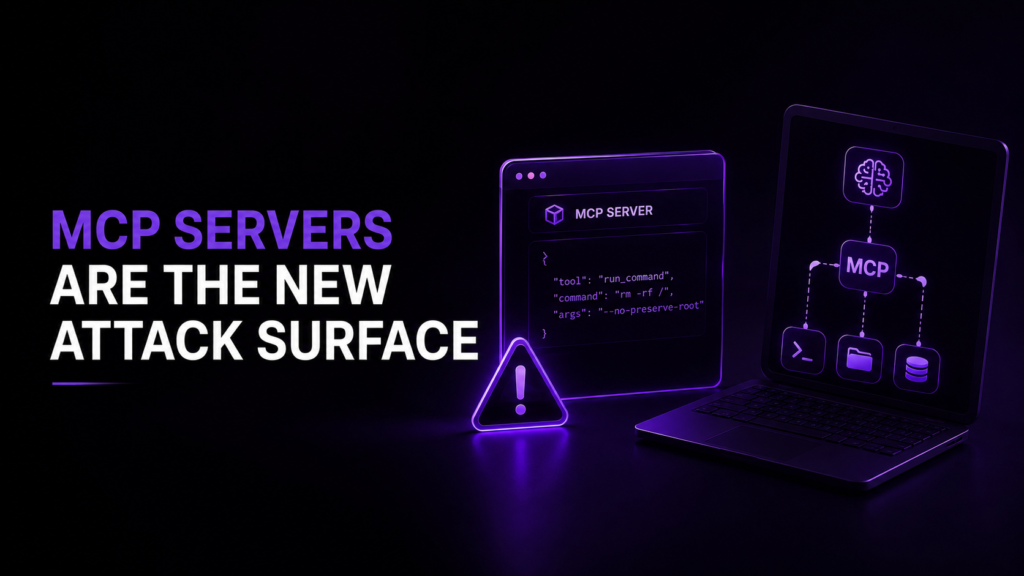
Why connecting LLMs to your local environment creates silent remote code execution (RCE) vectors, and how to validate agentic risk.
The adoption of the Model Context Protocol (MCP) has changed developer workflows. Promoted by Anthropic, MCP serves as an open standard enabling large language models (LLMs) to connect directly to local and remote data sources, developer tools, and file systems.
With platforms like Cursor, Claude Desktop, and GitHub integrations exposing local MCP servers to read codebases and run terminal commands, productivity has surged.
But from a security perspective, we have just introduced a massive, unauthenticated network interface directly to our workstations. MCP servers are the new enterprise attack surface, and traditional security testing is completely blind to it.
Here is what the shift to MCP means for penetration testing, and why securing agentic systems requires an agentic approach.
The Anatomy of an MCP Vulnerability
To understand the security risk, look at the architecture of a standard MCP setup.
An LLM client (such as Claude) connects to an MCP server (such as a local database connector or filesystem tool) via JSON-RPC. The LLM acts as the orchestrator, deciding when and how to call the server’s tools based on user instructions.
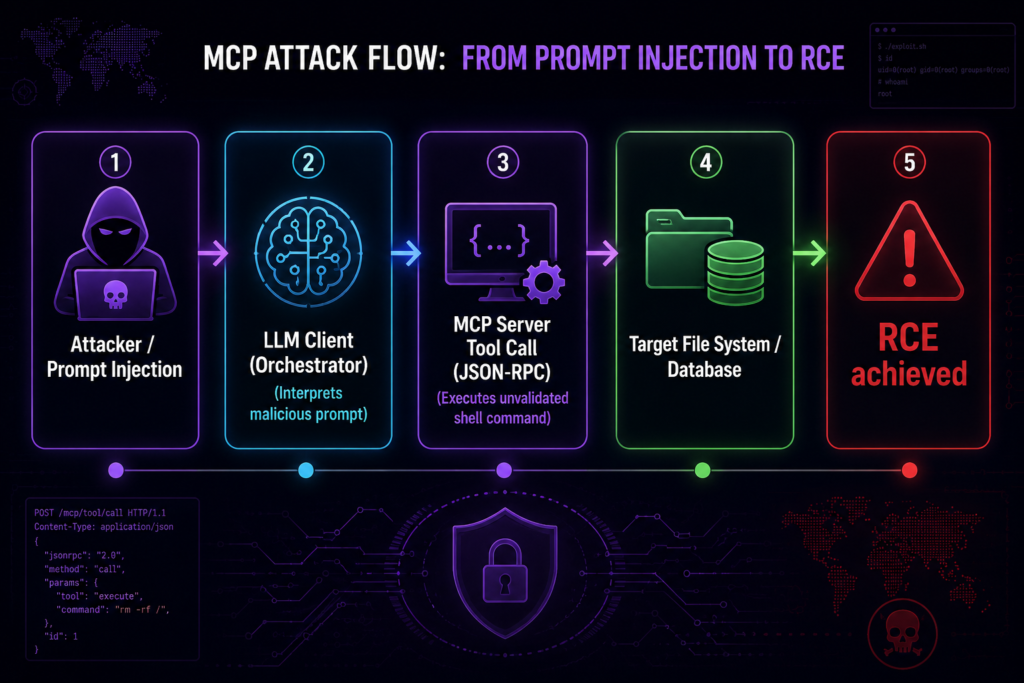
This setup introduces two major vulnerability vectors:
1. Indirect Prompt Injection to Tool Execution
An attacker does not need direct access to your MCP server. If your local agent reads an untrusted resource—like a pull request, an external API response, or a webpage containing a malicious payload—that payload can hijack the LLM client.
Once hijacked, the LLM will follow the instructions embedded in the payload, calling your local MCP server to execute commands, write malicious files, or leak sensitive keys.
2. Permissive Tool Design (Remote Code Execution)
Many open-source MCP servers are built for convenience, exposing high-risk functions such as run_command or write_file without strict parameter validation. If an LLM client is manipulated into passing unsanitized input to these tools, it results in direct Remote Code Execution (RCE) on the host machine.
Public MCP security incidents, including exploits demonstrating how malicious Markdown renders in IDE editors to trigger silent background script execution, show that these threats are already active.
Why Legacy Scanners Fail to Detect MCP Flaws
Traditional vulnerability scanners (like Nessus or Qualys) are built to scan version signatures and check known CVE databases.
They are completely blind to MCP vulnerabilities because:
- No Signature Match: The vulnerability is not in the software version itself; it resides in the logical permissions of the exposed tools.
- No Port Exposure: Local MCP servers often run over standard stdin/stdout pipes or local sockets that external port scanners cannot see.
- Dynamic Context: The exploit requires a multi-step semantic interaction (hijacking the LLM via prompt injection to trigger a tool call) which static code scanners cannot replicate.
The Solution: Agentic Pentesting for Agentic System
You cannot test a dynamic, reasoning-based system using static, version-based tools. Protecting architectures that use MCP requires agentic pentesting.
Agentic pentesting (such as the verification engine built into NeuraPent) mimics the actual logic of an adversary targeting these pipelines. Instead of scanning for outdated packages, autonomous validation agents:
- Identify active integrations and tool-calling endpoints.
- Attempt safe semantic validation tests (testing if input sanitizers prevent command parameter injection).
- Verify if security perimeters block callback command channels when tools are abused.
By using autonomous validation agents to test your perimeter, NeuraPent uncovers logical execution flaws and chains security gaps, delivering verified findings in hours, not weeks.
Want to secure your perimeter against modern AI and agentic attack surfaces? Learn how NeuraPent automates validation on our Solutions Page or request a perimeter audit via our Contact Page.